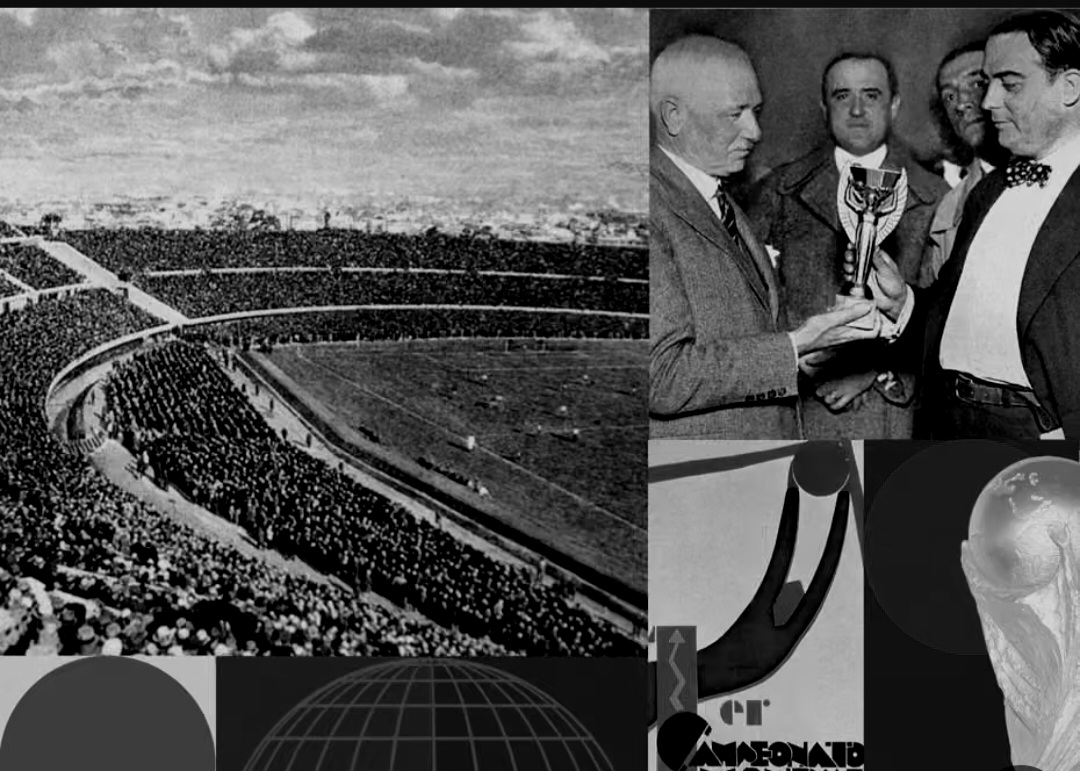
It’s a great example of how sport and politics were intertwined long before that became a cliché. Uruguay’s rise wasn’t just a “football miracle” — it was carefully enabled by diplomacy, state policy, and a bit of opportunism.
What stands out is how deliberate the strategy became. Figures like Juan Campisteguy and Jules Rimet clearly understood that hosting and winning a global tournament could project national identity far more effectively than traditional diplomacy. In that sense, Uruguay wasn’t just participating in sport — it was using football as a form of soft power decades before the term existed.
The 1924 Olympic win is especially striking. Entering the tournament almost by accident, then suddenly becoming a global sensation, shows how unpredictable these cultural moments can be. Yet Uruguay capitalized on it brilliantly: turning victory into a narrative of modernity, education, and national distinction. That connection to batllismo — the idea that a progressive, state-led society could produce excellence — makes the football success feel like a political proof-of-concept rather than just a sporting triumph.

There’s also a slightly precarious side to it. The anecdote about mortgaging a house to fund the यात्रा reminds you how fragile the whole project was at the start. It could easily have gone wrong. Instead, it became foundational to Uruguay’s identity and even helped justify hosting the 1930 FIFA World Cup.
And then you see how quickly the model gets adopted — and distorted. By the time Benito Mussolini uses the 1934 FIFA World Cup, the idea of football as a national showcase is no longer subtle. It becomes overt propaganda. That contrast is telling: Uruguay’s use feels like nation-building and self-assertion, while Mussolini’s is more about regime validation and ideological display.
Overall, it reinforces a broader point: international sport has rarely been “just sport.” From the beginning, it’s been a stage for identity, legitimacy, and power — and Uruguay was one of the first countries to really understand how to use it effectively.
With the 2026 FIFA World Cup, you don’t have one state projecting one identity. You’ve got three countries—United States, Canada, and Mexico—with different political systems, cultures, and global reputations. That alone dilutes the classic “single narrative” model we saw with Uruguay in 1930 or Italy in 1934.
If anything, the message may be less about national supremacy and more about regional coordination and contrast:
The US will likely lean into scale, commercial power, and its status as a global entertainment hub—less ideological projection, more spectacle and infrastructure.
Canada may emphasize inclusivity, diversity, and organizational competence—soft power in a quieter, reputational sense.
Mexico, with its deep football culture, could project authenticity and passion, reinforcing its identity as a spiritual home of the game in the region.
So instead of one story, you get a composite image of North America—which is messy, plural, and arguably more reflective of the modern world.
There’s also a shift in how audiences interpret these events. In the eras of 1930 FIFA World Cup or 1934 FIFA World Cup, governments had far more control over the narrative. Today, global media, social platforms, and scrutiny mean the “image” is contested in real time. For example, the tournaments in Russia and Qatar were as much about criticism and debate as they were about projection.
That cuts both ways for 2026:
It can still bind populations together, especially locally in host cities.
But it’s less likely to produce a unified national myth in the way Uruguay managed.
And it may highlight differences—on immigration, identity, economics—just as much as shared values.
So if Uruguay set the template, 2026 might represent its evolution: not a single, coherent act of nation-building, but a fragmented, multi-voiced display of what modern nations (and regions) actually are.