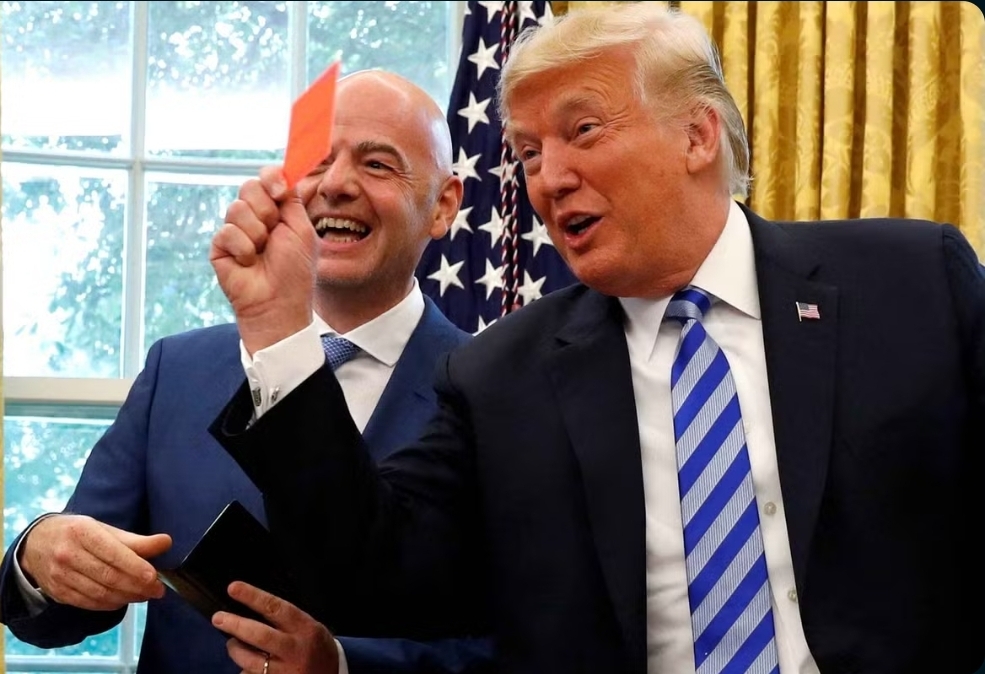
President Donald Trump’s intervention in the Folarin Balogun red card controversy has ignited a fresh debate about politics, fairness, and the boundaries of influence in international sport. The U.S. president confirmed Monday that he asked FIFA president Gianni Infantino to review what he called the “horrible” decision to send off the star American striker, but he insisted he did not demand the punishment be overturned. The episode has drawn intense attention not only because of the match itself, but because of the unusual way a head of state entered a disciplinary matter that is normally left to referees and football officials.
Trump said he contacted Infantino because he did not believe the challenge warranted a red card. “I asked for a review because I didn’t think it was a foul,” he told reporters at the White House. “All I did was ask for a review, I didn’t say you have to do this.” He added that the incident “wasn’t even an infraction,” describing it as “two guys running full speed that happened to crash into each other.”
The remarks came after Balogun was set to miss the United States’ last-16 knockout match against Belgium following a straight red card in the team’s 2-0 win over Bosnia in the round of 32. The card was issued after a video review determined that Balogun had stepped on the foot of a Bosnian defender. Under standard FIFA rules, a straight red card triggers an automatic one-game suspension, and teams are not allowed to appeal the ban. But FIFA later suspended the sanction for a year after the personal appeal from Trump, setting off a wave of criticism from supporters of competitive integrity and football governance.

Trump’s criticism of the referee
Trump did not stop at questioning the foul itself. He also took aim at referee Raphael Claus, the Brazilian official who made the call after video review. Describing Claus as “a little bit suspect if you check his past,” Trump suggested the decision might reflect a broader pattern rather than a single controversial moment. Such comments only intensified the controversy, shifting the discussion from one disputed challenge to the larger issue of whether political leaders should publicly scrutinize match officials.
For many observers, the president’s language echoed his well-known style of framing unfavorable outcomes as biased or unfair. That tone was unmistakable when he said the rule preventing Balogun from playing in the next round was “very unfair.” His comments appeared designed to question not just the individual decision but the structure of the disciplinary system itself.
How the red card was changed
FIFA’s handling of the matter is what has most surprised critics. A straight red card is generally one of the clearest disciplinary measures in football, reserved for serious foul play or violent conduct. Because it carries an automatic suspension, there is usually little room for reinterpretation once it has been issued. In this case, however, FIFA said the ban would be suspended for one year after Trump’s direct communication with Infantino.
That decision is highly unusual. Even when match officials make mistakes, the procedural rules of the sport are intended to provide consistency and predictability. Once exceptions begin to be made, critics argue, the appearance of fairness weakens. The concern is not only whether Balogun deserved the card, but whether a player’s availability can be influenced by political pressure rather than the normal disciplinary process.
Balogun’s importance to the U.S. team
The timing of the decision mattered greatly. Balogun is one of the U.S. team’s most important attacking players, and his availability for a knockout match against Belgium could significantly affect the Americans’ chances of advancing. Trump acknowledged that he was initially unaware the red card meant Balogun would be suspended for the next game, later saying the rule seemed unjust.
That uncertainty adds another layer to the controversy. If the president did not fully understand the consequences at first, the decision to intervene may have been driven more by a general reaction to the call than by a detailed grasp of the disciplinary framework. Still, once the matter was raised at the highest level, it became impossible to separate the sporting issue from the political one.
Trump framed the situation in competitive terms, saying, “We’re going to have a full team, and Belgium is going to have a full team, and you know what? If they beat us, then they can be really proud.” He suggested that such an outcome would make the result more legitimate. But he also left no doubt about how he might view a loss if the decision had stood, saying, “The other way, if they beat us… I say it was rigged, just like the election was rigged in 2020.”
That last remark immediately reignited criticism from opponents who noted that Trump was repeating false claims about the 2020 U.S. presidential election. Bringing those allegations into a football controversy only sharpened the sense that the event had become part sports dispute, part political theater.
Belgium’s response
Belgian football officials did not hide their frustration. They issued a statement saying they were “astonished” by the move, adding that it was in “direct contradiction” with FIFA’s own rules. Their reaction reflects a broader concern among football administrators: if one team benefits from outside intervention, the legitimacy of the competition may be questioned.
From Belgium’s perspective, the issue is straightforward. If the governing rules state that a straight red card leads to an automatic suspension and cannot be appealed, then relaxing that rule for one player — especially after a call from a head of state — looks inconsistent. Even if the sporting outcome appears harmless in isolation, the precedent can be damaging.
Why the case matters beyond one match
The Balogun incident is about more than one striker or one game. It raises important questions about how football balances authority, transparency, and discretion. VAR already changed the sport by allowing officials to revisit key moments, but those reviews are still supposed to operate within a defined rulebook. When external influence enters the picture, especially from political leaders, the line between governance and interference becomes harder to define.
It also highlights how modern football increasingly exists in the same media ecosystem as politics. A single decision on the field can become a national controversy in minutes, and public figures often feel pressure to react. Yet there is a difference between expressing an opinion and altering a disciplinary outcome. That difference is at the heart of the debate surrounding Trump’s call to Infantino.
A controversy likely to linger
Whether Balogun’s red card was a harsh decision or not, the larger story is now fixed: a president intervened, FIFA changed course, and rivals objected. For supporters of the United States, the result may simply be the chance to see a key player on the field against Belgium. For critics, it is a troubling example of how influence can bend supposedly neutral sporting rules.
In the end, the controversy may have lasting consequences far beyond this tournament. It has placed FIFA under scrutiny, raised questions about consistency in disciplinary decisions, and once again shown how easily sport can become entangled with politics. Even if the match itself proceeds without further drama, the debate over what happened before it is unlikely to fade anytime soon.