The Biggest Scandals in Football History: When the Beautiful Game Turns Ugly
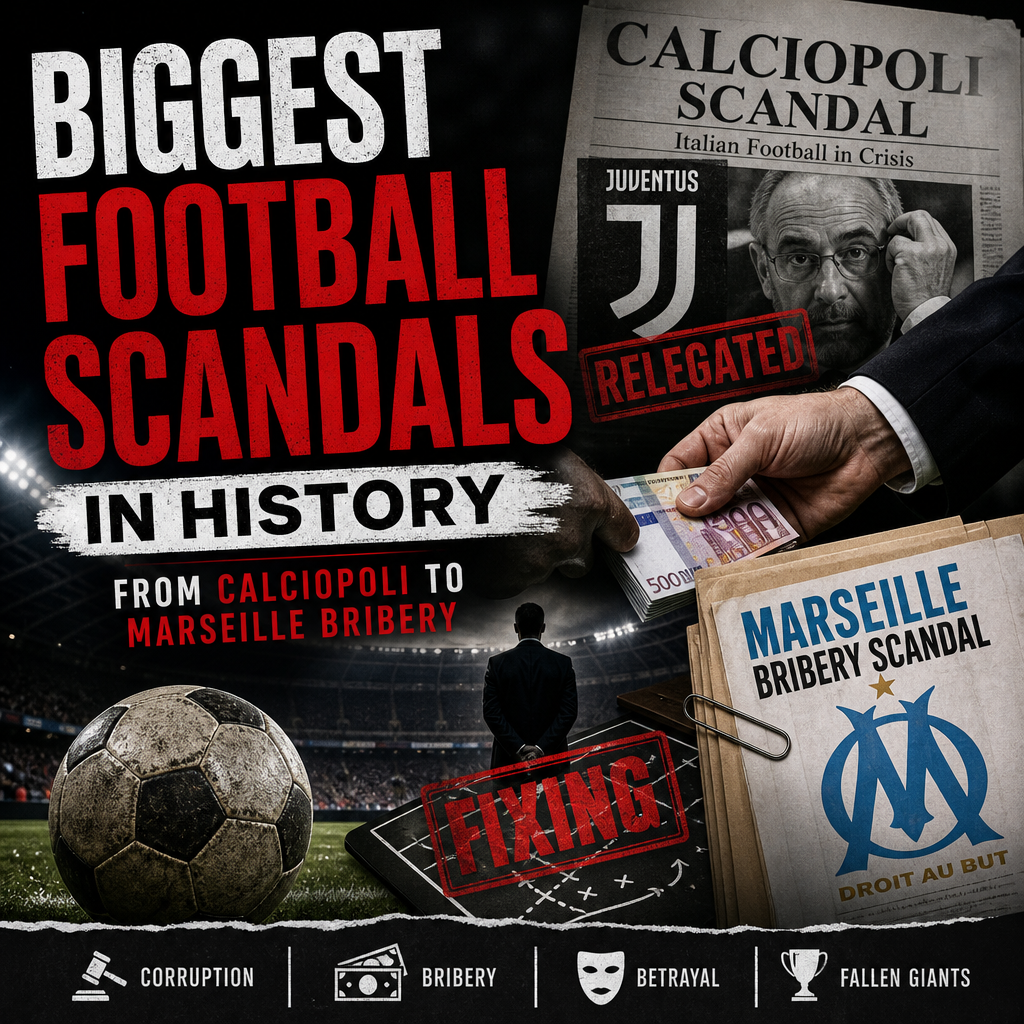
Every now and then, the football world gets shocked by a major scandal. Sometimes it’s betting-related, sometimes it’s match-fixing, and other times it involves circumventing financial rules. The football world, like any other sporting universe, is vulnerable to scandals—an unfortunate reality when so many people are involved with so much at stake. Over the years, some incidents have left a lasting mark, shaking fans’ trust and the sport’s integrity. Here, we take a look at some of the biggest scandals in football history, from Calciopoli in Italy to bribery in French football.
The Calciopoli Scandal (2004-2006)
Who Was Involved?
- Juventus
- AC Milan
- Lazio
- Fiorentina
- Arezzo
- Reggina
- Siena
- Triestina
- FIGC (Italian Football Federation)
What Happened?
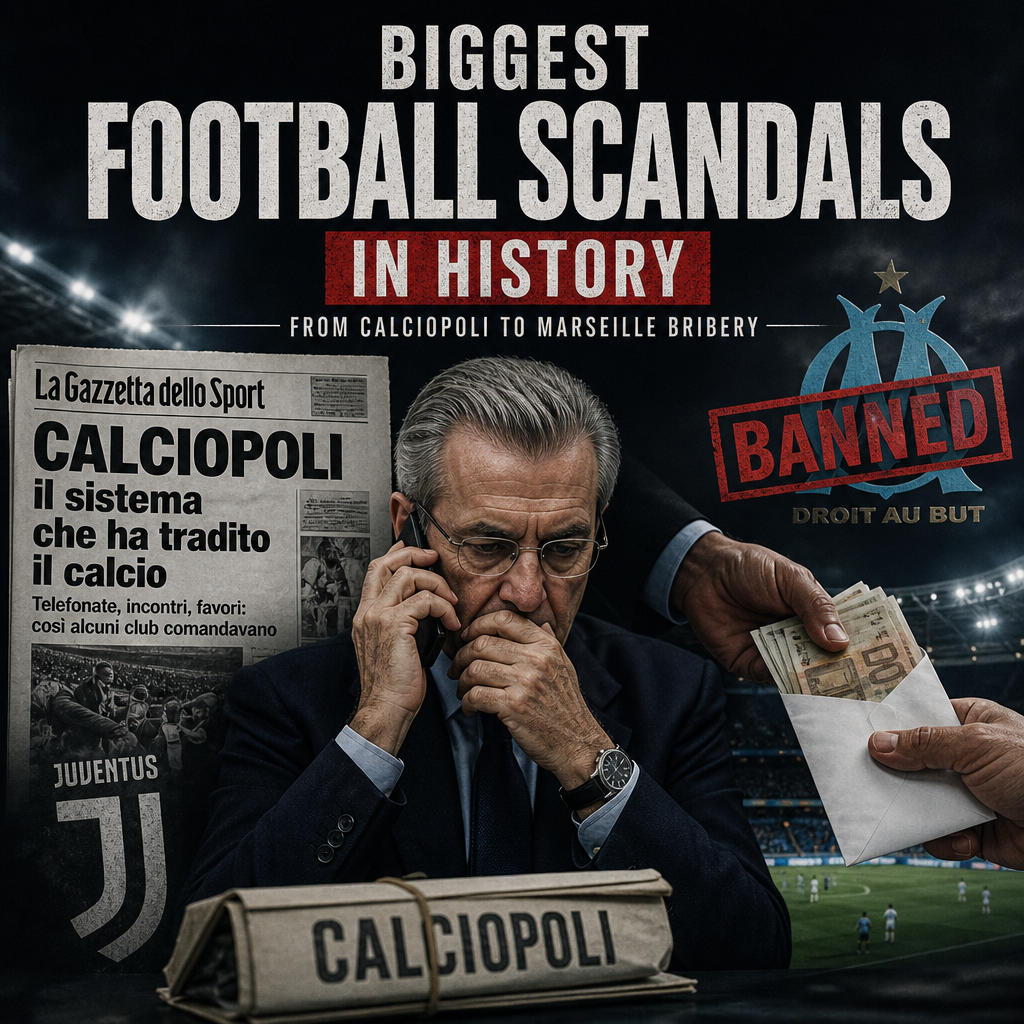
The Calciopoli scandal rocked Italian football after the 2005-06 season when it was revealed that Juventus director Luciano Moggi had orchestrated a vast match-fixing scheme. Initially investigated for potential doping, tapped phone calls unveiled a network where Moggi influenced referees assigned to officiate Serie A games, benefitting Juventus and other clubs.

He reportedly requested specific referees who would favor Juventus, with some referees receiving payments to suspend players from opposing teams or to manipulate matches subtly. The scandal widened as investigations also implicated executives from Milan, Lazio, and Fiorentina, who were accused of trying to influence referees and various officials to sway results in their favor.
The Investigation
- 19 Serie A matches from the 2004-05 season were scrutinized.
- 9 referees and 41 suspects including club presidents, executives, and FIGC officials came under review.
- The scandal represented one of the most extensive corruption probes in Italian sports history.
Punishments and Repercussions
- Juventus was stripped of their 2005 and 2006 Serie A titles.
- They were relegated to Serie B with a 9-point penalty and fined €75,000.
- Luciano Moggi and Juventus CEO Antonio Giraudo received lifetime bans from football.
- Fiorentina faced relegation but remained in Serie A after appeal, starting with a 15-point deduction and banned from the 2006-07 Champions League.
- Lazio initially relegated, ended with a 3-point deduction and UEFA Cup ban after appeal.
- Milan began the following season with an 8-point penalty and were excluded from the Champions League.
- Reggina, a Serie B side, was penalized 11 points.
- No Serie A champion was declared for the 2004-05 season.
The scandal severely undermined Italian football’s reputation for years, leading to significant reforms in governance and refereeing.
Marseille’s Bribery Scandal (1993)
Who Was Involved?
- Olympique Marseille (OM)
- Valenciennes
- Bernard Tapie (OM club president)
- Jean-Pierre Bernes (OM general manager)
- Jean-Jacques Eydelie (OM midfielder)
- Jorge Burruchaga, Jacques Glassmann, Christophe Robert (Valenciennes players)
What Happened?
In a shocking episode just before the 1993 Ligue 1 clash between Marseille and Valenciennes, OM’s leadership sought to manipulate the match. The goal was to keep OM’s players fresh for the upcoming UEFA Champions League final against AC Milan by ensuring an easy victory and a less intense match.
OM instructed midfielder Jean-Jacques Eydelie to bribe certain Valenciennes players to underperform. Two players, Burruchaga and Robert, accepted the bribes, with Robert convincing his team to tank the match, which Marseille won 1-0. However, the third player, Jacques Glassmann, refused and bravely reported the bribery attempt.
Investigation and Fallout
The referee and Valenciennes’ manager noticed unusual play and reports soon led to a police investigation. French police even raided OM’s dressing room after the match. The scandal unravelled quickly, casting a shadow on Marseille’s title and threatening the integrity of French football.
Consequences
- Marseille was stripped of their 1993 Ligue 1 title.
- Bernard Tapie resigned from his position amidst the ensuing controversy.
- Several individuals received bans and sanctions.
- The scandal dented Marseille’s reputation but also served as a stark warning against corruption in football.
Conclusion
Scandals like Calciopoli and Marseille’s bribery case illustrate that even football’s most revered leagues and institutions are not immune to corruption. The high stakes involved—financial rewards, trophies, and global prestige—make the temptation to cheat very real. However, the fallout from these scandals also demonstrates football authorities’ willingness to act decisively to protect the sport’s integrity.
Football continues to be the beautiful game billions love, but these historic scandals are reminders that vigilance, transparency, and fair play must always be upheld to ensure the sport remains true to its spirit.