A Track Record of Accurate Predictions
 Klement’s track record is impressive: – 2014 Brazil: Predicted Germany, who went on to win. – 2018 Russia: Correctly chose France. – 2022 Qatar: Forecasted Argentina’s victory. Initially, Klement set out to prove that predicting the World Cup winner was almost impossible. Speaking to Der Spiegel, he reflected on his first unexpected success: > “The first time I was horrified when Germany became world champions in Brazil, also because all the experts had pointed out that no European team had ever won a World Cup in South America.” This moment marked the start of confidence in his mathematical model, which integrates several key variables to predict outcomes.
What Makes Klement’s Model Unique?
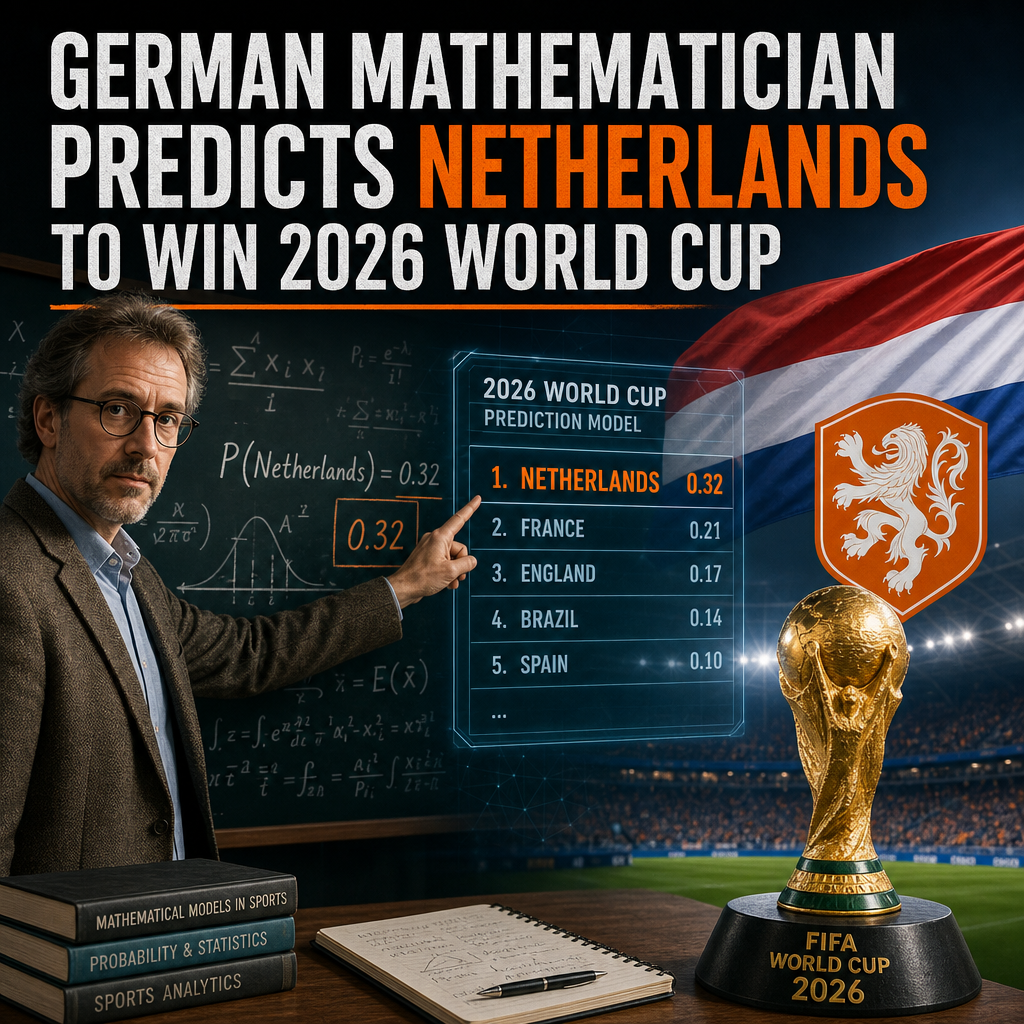
Unlike simple guesswork or pundit opinions, Klement’s model uses data-driven analysis to evaluate country performance in football. The model includes: – GDP per capita: Reflects the nation’s wealth, impacting sports infrastructure and training quality. – Population size: Larger talent pools often mean better chances. – Football’s societal status: How deeply football is embedded in a country’s culture and priorities. – National team global rankings: Current performance levels against other nations. – An element of chance: Recognizing the unpredictable nature of football. By combining these factors, the model provides a probabilistic outlook rather than a definitive answer, allowing for surprises and upsets.
How the Tournament Will Unfold According to Klement
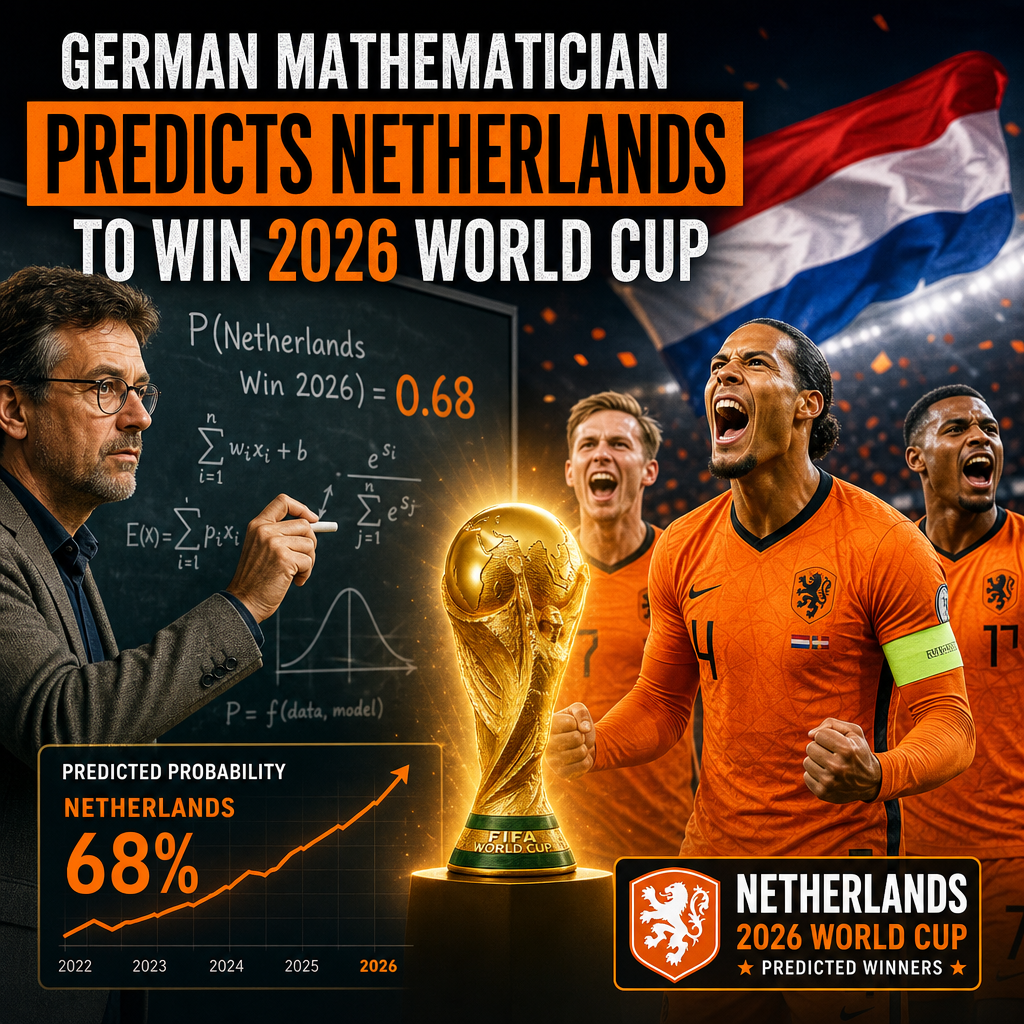
Klement predicts an exciting path to the final with the following key matches: – Semifinals: – Netherlands vs. Spain – Portugal vs. England – Final: – Netherlands vs. Portugal According to the model, the Netherlands will edge out Spain in the semifinal and then upset Portugal in the final to claim their first World Cup crown.

The Netherlands: A Nation Chasing Glory
The Netherlands has been close to winning but never clinched the World Cup title, having reached the final three times (1974, 1978, and 2010), only to fall short each time. This prediction, if it comes true, would complete a historic breakthrough for Dutch football.
A Cautious Note: Predictions Are Not Guarantees
Despite past successes, Klement remains cautious about the reliability of his predictions. He openly warns fans and bettors against taking his forecasts too seriously: > “It’s completely irrational. It’s like playing the lottery.” > “If anyone places a bet based on my prediction of who will be the next world champion, they’re beyond help.” He compares soccer predictions to coin tosses, where a successful streak doesn’t guarantee consistent future results.
Why Klement’s Work Matters
While Klement’s model is not foolproof, it highlights how data analytics can contribute to understanding complex sports outcomes. With the growing use of statistics in football, such predictive models are gaining popularity among analysts, commentators, and fans. Klement’s 2026 World Cup prediction shines a spotlight on the Netherlands’ potential and adds an intriguing narrative to the upcoming tournament. — In summary, Joachim Klement’s mathematical model is back in the spotlight with a bold bet on the Netherlands for the 2026 World Cup winner. With historical accuracy and a scientifically grounded approach, Klement’s insight adds excitement to the beautiful game — even as he reminds us that football, like life, still leaves plenty to chance.