Referee Kovacs Reportedly Removed from Champions League Duty Following Controversial Barcelona-Atletico Clash
Referee Kovacs will reportedly not officiate another Champions League match this season after his contentious handling of a critical moment in the quarter-final first leg between Barcelona and Atletico Madrid at the Spotify Camp Nou. This decision, as revealed by the Cope radio program “El Partidazo,” highlights the high stakes and intense scrutiny referees face in Europe’s premier club competition, especially when key disciplinary decisions prove controversial.
The Pivotal Incident: Pau Cubarsi’s Foul and the Delayed Red Card
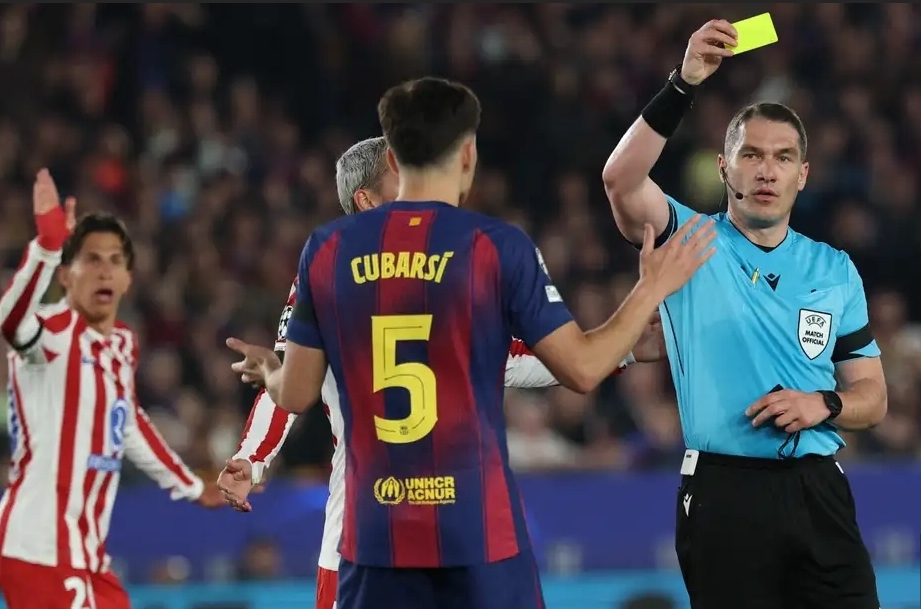
The crux of UEFA’s dissatisfaction with referee Kovacs centered on how he managed a foul committed by Barcelona’s young centre-back Pau Cubarsi. During the heated quarter-final clash, Cubarsi brought down Giuliano Simeone inside the penalty area. Initially, Kovacs issued only a yellow card for the foul. However, after consultation with the Video Assistant Referee (VAR), the decision was upgraded to a straight red card.

This delay in issuing the red card was deemed a significant officiating error by UEFA officials. In top-level football, especially in competitions where emotions run high, the consistency and immediacy of disciplinary actions are paramount for maintaining fairness and control. The failure to send off Cubarsi immediately not only affected the flow of the game but also sent mixed signals regarding the enforcement of the rules.
Isaac Fouto, a well-known Spanish journalist, discussed UEFA’s position during “El Partidazo de Cope.” He confirmed that Kovacs had been removed from the elite rotation due to this particular mistake, stating, “Yesterday’s referee will not officiate again, but for the error of not sending off Cubarsí live.”
UEFA’s Approach to Refereeing Standards in the Champions League
UEFA’s decision to exclude Kovacs from further matches underscores the governing body’s commitment to upholding the highest refereeing standards in the Champions League. Since VAR was introduced, expectations have risen for referees to act decisively and utilize technological tools effectively to ensure accurate decisions—especially in critical moments.
The enforcement of strict disciplinary actions, such as immediate red cards for violent or professional fouls, is essential to the credibility of the tournament. Any delay or hesitation can lead to unfair advantages, influence game outcomes, and fan frustration. Kovacs’ handling of the Cubarsi incident has been classified as a serious lapse in judgment, prompting UEFA to take swift action.
Additional Controversies: Hansi Flick’s Criticism of Officials
While UEFA’s focus was mainly on the Cubarsi red card incident, Barcelona’s coach Hansi Flick expressed frustration about a different refereeing decision during the same match. Following Barcelona’s 2-0 defeat, Flick criticised the officials for what he perceived as a missed penalty and carding opportunity.
The incident involved Marc Pubill, who appeared to handle the ball inside the penalty area after a short goal kick from Atletico goalkeeper Juan Musso. Flick called out the refereeing team for their failure to intervene through VAR, stating in an interview with Movistar: “I don’t know why VAR didn’t intervene. We all make mistakes, but what’s the point of VAR? I can’t understand it. It should be a penalty, a second yellow card, and a red. This is what can’t happen.”
Flick’s comments reflect growing tensions about VAR’s inconsistent implementation—an ongoing debate in football circles. The Barcelona coach’s anger highlights how match-deciding moments hinge not only on player performance but also on refereeing decisions and technological assistance.
The Impact of Refereeing Decisions on High-Stakes Matches
Referee Kovacs’ removal from Champions League duty illustrates the broader impact that officiating can have on pivotal fixtures. In tournaments where every decision has potential ramifications for the teams’ futures, precision and transparency are critical. UEFA’s handling of Kovacs’ error sends a signal to referees that accountability is paramount and that lapses will carry consequences—even for experienced officials in the elite category.
For fans and teams alike, the controversy around Cubarsi’s red card and the missed penalty call adds another layer of drama to an already intense Barcelona-Atletico rivalry. Going forward, it raises questions about how UEFA and match officials will continue to integrate VAR technology to reduce human error and ensure fair play.
Conclusion
The decision to sideline referee Kovacs for the remainder of the Champions League season following the Barcelona-Atletico Madrid quarter-final first leg showcases UEFA’s strict stance on officiating quality. The mishandling of Pau Cubarsi’s disciplinary action, combined with Barcelona’s coach Hansi Flick’s criticism of other refereeing oversights, highlights the challenges referees face in high-pressure games. It also underlines the ongoing calls for improved consistency and transparency in the use of VAR to enhance the integrity of football’s biggest stage.