Ever watched a match with your mates and felt like they were speaking another language? All that talk of odds, accumulators, and bookies can seem like a complicated world to enter. But here’s a secret: it’s much simpler than you think.
Welcome to your complete beginner’s guide to sports betting. Forget the confusing jargon and the intimidating numbers. We’re here to explain, simply and clearly, what sports betting is, how it works, and how you can place your first bet safely and confidently. Think of this as your first step to understanding the game behind the game.
How Does Sports Betting Actually Work?
At its very core, sports betting is straightforward. It’s a wager you place on the outcome of a sporting event. You are essentially predicting a result, and if you’re correct, you win money. If you’re incorrect, you lose the money you wagered.

This wager is made between you, the individual (often called a punter), and a company that accepts the bet, known as a bookmaker (or bookie). It’s a simple arrangement, but the magic lies in the details—specifically, the terms, the odds, and the potential payout.
Key Betting Terms Explained
Before we go any further, let’s get three basic terms clear. These are the absolute fundamentals of betting.
The Bookmaker (or ‘Bookie’)
A bookmaker is a licensed company that takes your bet. They analyse sporting events and calculate the probability of all possible outcomes. Based on this, they offer “odds” to the public, which you can then bet on.
The Stake
The stake is simply the amount of money you decide to bet. For example, if you place a £5 bet on Manchester United to win, your stake is £5. You should only ever stake what you are comfortable with losing.
The Odds
Odds represent two things:
The likelihood (or probability) of an outcome happening.
How much money you will win if your prediction is correct.
Understanding odds is the most important skill for any new punter, so let’s dedicate a whole section to it.
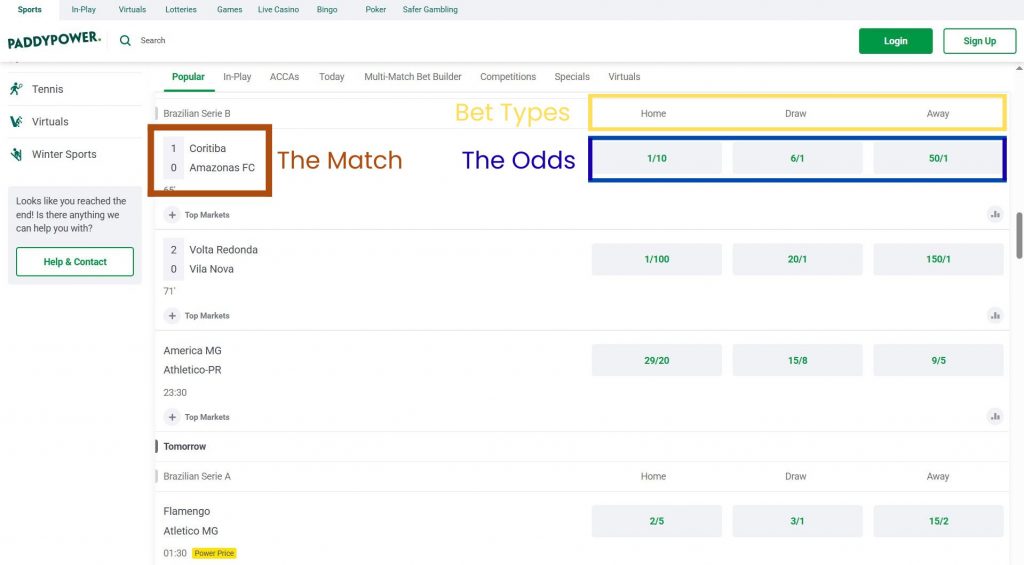
Understanding Betting Odds: What Do the Numbers Mean?
When you look at a UK betting site, you’ll traditionally see odds displayed as fractions, like 5/1 or 7/4. They might look like a bit of school maths, but the rule behind them is very simple and tells you your potential profit instantly.
The rule is this: for every amount on the right side of the fraction you stake, you will win the amount on the left side in profit.
For example, with odds of 5/1 (read as “five to one”), it means: For every £1 you stake, you will win £5 in profit.
Of course, if you win, you also get your original stake back.
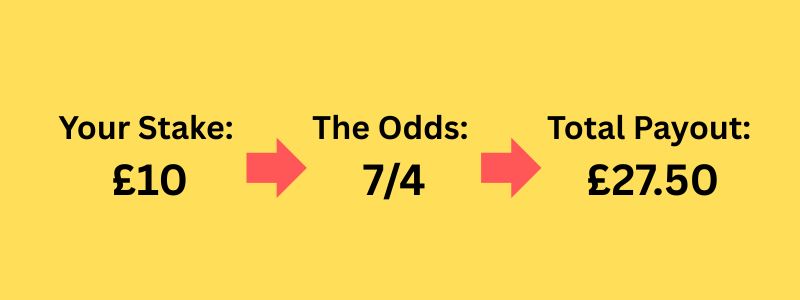
Let’s use a more typical example. Imagine Manchester United are playing Liverpool, and the odds for a Man Utd win are 7/4.
You decide to place a £10 stake. How do you calculate the profit?
Here’s the formula: (Your Stake / number on the right) x number on the left = Your Profit
So, for our example: (£10 / 4) * 7 = £2.50 * 7 = £17.50 profit
If Manchester United win, your total payout will be £27.50 (your £17.50 profit + your original £10 stake).
What About Decimal Odds?
On most modern betting sites, you have the option to switch to Decimal odds (e.g., 2.75), which some people find simpler. They are common in Europe and online.
The key difference is that decimal odds already include your stake in the calculation. Fractional odds of 7/4 are the exact same as decimal odds of 2.75.
The calculation is just: Stake x Decimal Odds = Total Payout.
So, £10 x 2.75 = £27.50.
As you can see, the result is identical! It’s purely a matter of preference.
Is Sports Betting Legal in the UK?
Yes, absolutely. Sports betting in the United Kingdom is fully legal and one of the most well-regulated markets in the world.
To operate legally, a bookmaker must hold a licence from the UK Gambling Commission (UKGC). The UKGC is the official government body responsible for making sure that all betting is fair and safe. They protect players, ensure bookies pay out winnings, and promote responsible gambling. Always check for the UKGC logo at the bottom of a betting site before you sign up.

How to Get Started: Your First Bet in 5 Simple Steps
Ready to give it a go? Here is a simple, five-step process to placing your first bet.
Choose a Licensed Bookmaker: The first step is to select a betting site that is licensed by the UK Gambling Commission. This guarantees your money and data are safe.
Create an Account: You’ll need to provide some basic personal details, like your name, address, and date of birth (you must be 18 or over). You will also need to verify your identity, which is a standard security procedure.
Deposit Funds: Add money to your account using a debit card or another payment method like PayPal. It’s always wise to start with a small amount.
Find a Sport and Match: Navigate the site to find the sport you’re interested in, whether it’s football, horse racing, or tennis. Select the specific match or event you want to bet on.
Place Your Stake: Click on the odds for the outcome you want to predict. This will add it to your “bet slip.” Enter your desired stake (e.g., £5), check your potential payout, and click the “Place Bet” button to confirm.
Conclusion: You’re Ready to Go
And that’s it. You now understand the basics of sports betting. You know what a bookie is, what a stake is, and most importantly, what the odds mean. You also know that it’s a legal and regulated activity in the UK, and you have a clear five-step plan to place your first bet.
The key is to start small, only bet what you can afford to lose, and treat it as a form of entertainment.
Now that you understand the “what” and “how,” the next crucial step is choosing where to play. Our next guide will help you with just that.
Read Next: How to Choose a Bookmaker: A Guide to Finding the Best Betting Sites in the UK